
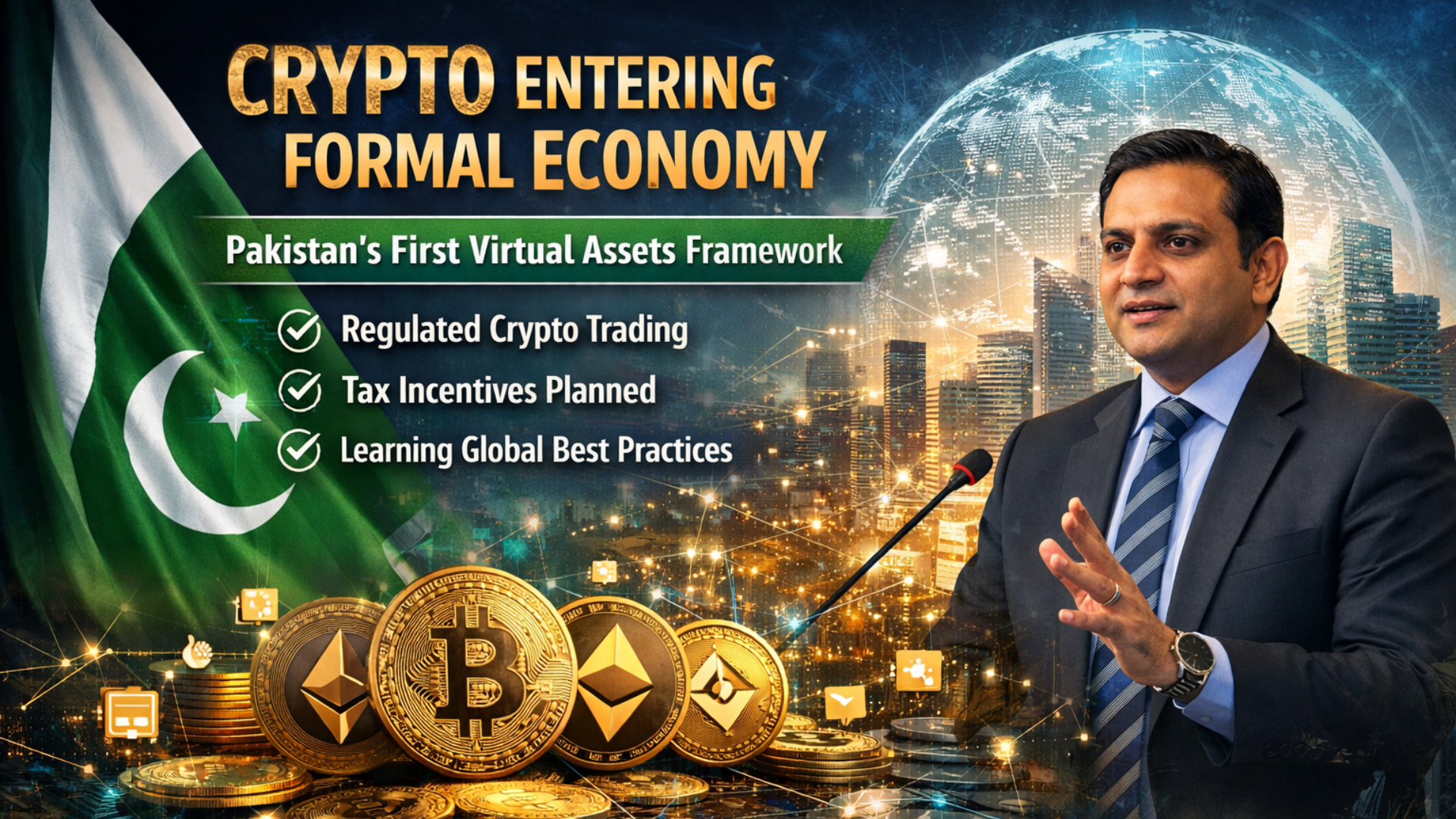

Crypto to Enter Formal Economy Under Pakistan’. Pakistan is preparing to bring cryptocurrencies and digital assets into the formal economy under its first-ever virtual assets regulatory framework, marking a major shift in the country’s digital and financial landscape. The move is part of a broader national strategy aimed at transforming Pakistan into a digitally empowered economy by 2026.
Speaking at a high-level technology forum, Advisor to the Finance Minister Khurram Schehzad made it clear that Pakistan’s digital agenda goes far beyond isolated reforms. According to him, “Digital Nation Pakistan 2026” represents a complete vision for modern governance, innovation-led growth, and financial inclusion.
Digital Nation Pakistan 2026: A Long-Term Vision
The Digital Nation Pakistan 2026 initiative is designed to lay the foundation for a fully digitized state. It focuses on transforming how the government operates, how citizens access services, and how businesses participate in the economy.
Khurram Schehzad emphasized that this initiative is not limited to technology adoption. Instead, it aims to restructure the entire economic and administrative system around digital processes. From public records to financial transactions, the government wants to ensure speed, transparency, and accountability across all sectors.
Pakistan Virtual Assets Regulatory Authority (PVARA): A New Era for Crypto
A key pillar of this transformation is the proposed Pakistan Virtual Assets Regulatory Authority (PVARA). Once established, this authority will regulate cryptocurrencies, digital tokens, and other virtual assets within a defined legal framework.
For crypto holders in Pakistan, this development is significant. Under the new framework:

- Digital asset holders will be able to operate within the formal economy
- Regulatory clarity will reduce legal uncertainty
- Compliance mechanisms will align with international standards
- Investor protection will be prioritized
This marks the first time Pakistan has moved toward recognizing virtual assets as part of its regulated financial ecosystem.
Tax Incentives Under Discussion for Crypto Participants
Khurram Schehzad revealed that tax incentives for virtual asset holders and investors are currently under discussion. While final details are yet to be announced, policymakers are exploring multiple options to encourage participation without discouraging innovation.
These incentives aim to:
- Promote transparency in crypto transactions
- Encourage voluntary compliance
- Attract domestic and overseas investment
- Support startups working in blockchain and fintech
The government’s approach signals a balance between regulation and growth, rather than heavy-handed restrictions.
FinTech Forward Forum at ITCN Asia 2026
The remarks were delivered during the FinTech Forward Forum, held as part of the 27th ITCN Asia exhibition at the Expo Centre.

ITCN Asia is one of South Asia’s largest technology events, bringing together policymakers, entrepreneurs, investors, and digital innovators. The forum focused on fintech evolution, digital governance, and the future of financial systems in emerging markets.
Government Digitalization: Progress So Far
Highlighting tangible progress, Khurram Schehzad shared that 99 percent of government files are now transferred digitally across ministries through the E-Office platform.
This shift has delivered measurable benefits:
- Elimination of data loss
- Faster inter-ministerial communication
- Reduced delays in decision-making
- Real-time performance tracking
- Improved transparency and accountability
The E-Office system is now a core component of Pakistan’s administrative operations.
120 Million Bank Accounts and Fully Digital G2G Transactions
Looking ahead, the government has set ambitious targets:

- 120 million bank accounts to be established nationwide
- 100 percent digital government-to-government (G2G) transactions
- Full migration of government systems onto a digital foundation
These goals are expected to expand financial inclusion, reduce cash dependency, and strengthen institutional efficiency across the public sector.
Support for Investors, SMEs, and Youth
During the question-and-answer session, Khurram Schehzad outlined several incentive-driven initiatives under the upcoming industrial policy.
Key Measures Include:
- Special incentives for investors, particularly in technology and innovation-driven sectors
- Small loans for SMEs, agriculture, and young entrepreneurs
- Skill bonds to reward and retain skilled professionals
These measures aim to promote self-sufficiency, job creation, and sustainable economic growth.
Empowering Youth Through Digital and Financial Policies
Youth empowerment remains a central theme of Pakistan’s digital strategy. According to the advisor, policies are being designed to enable young people to participate actively in:
- Financial services
- Digital platforms
- Emerging technologies such as blockchain and fintech
The government sees its role as an enabler—creating a supportive environment where innovation can thrive rather than imposing unnecessary barriers.

Virtual Assets Regulation: Learning From Global Models
On the regulatory front, Khurram Schehzad acknowledged that Pakistan is still in the early stages of developing its virtual assets framework. However, the country is studying global best practices to avoid common pitfalls.
He cited the United Arab Emirates as a leading example of effective virtual asset regulation. The UAE’s structured, innovation-friendly approach has helped it become a global hub for crypto and blockchain businesses.
Pakistan, he noted, is moving cautiously but confidently, ensuring that regulations protect users without stifling innovation.
Balanced Policymaking for a Digital Future
The session concluded with a strong emphasis on:
- Innovation-friendly regulations
- Balanced policymaking
- Compliance with international standards
- Long-term economic sustainability
Stakeholders agreed that digital transformation requires cooperation between government, private sector, and technology communities.

Why This Matters for Pakistan’s Economy
Bringing crypto into the formal economy could have wide-ranging impacts:
- Increased transparency in digital asset transactions
- New revenue streams through regulated taxation
- Greater investor confidence
- Growth of fintech and blockchain startups
- Stronger integration with global digital markets
If implemented effectively, the virtual assets framework could position Pakistan as a competitive player in the regional digital economy.
Conclusion
Pakistan’s move to regulate cryptocurrencies under its first virtual assets framework represents a defining moment for the country’s digital future. Through initiatives like Digital Nation Pakistan 2025, the creation of PVARA, and a strong focus on financial inclusion, the government is signaling its intent to embrace innovation while maintaining regulatory discipline.