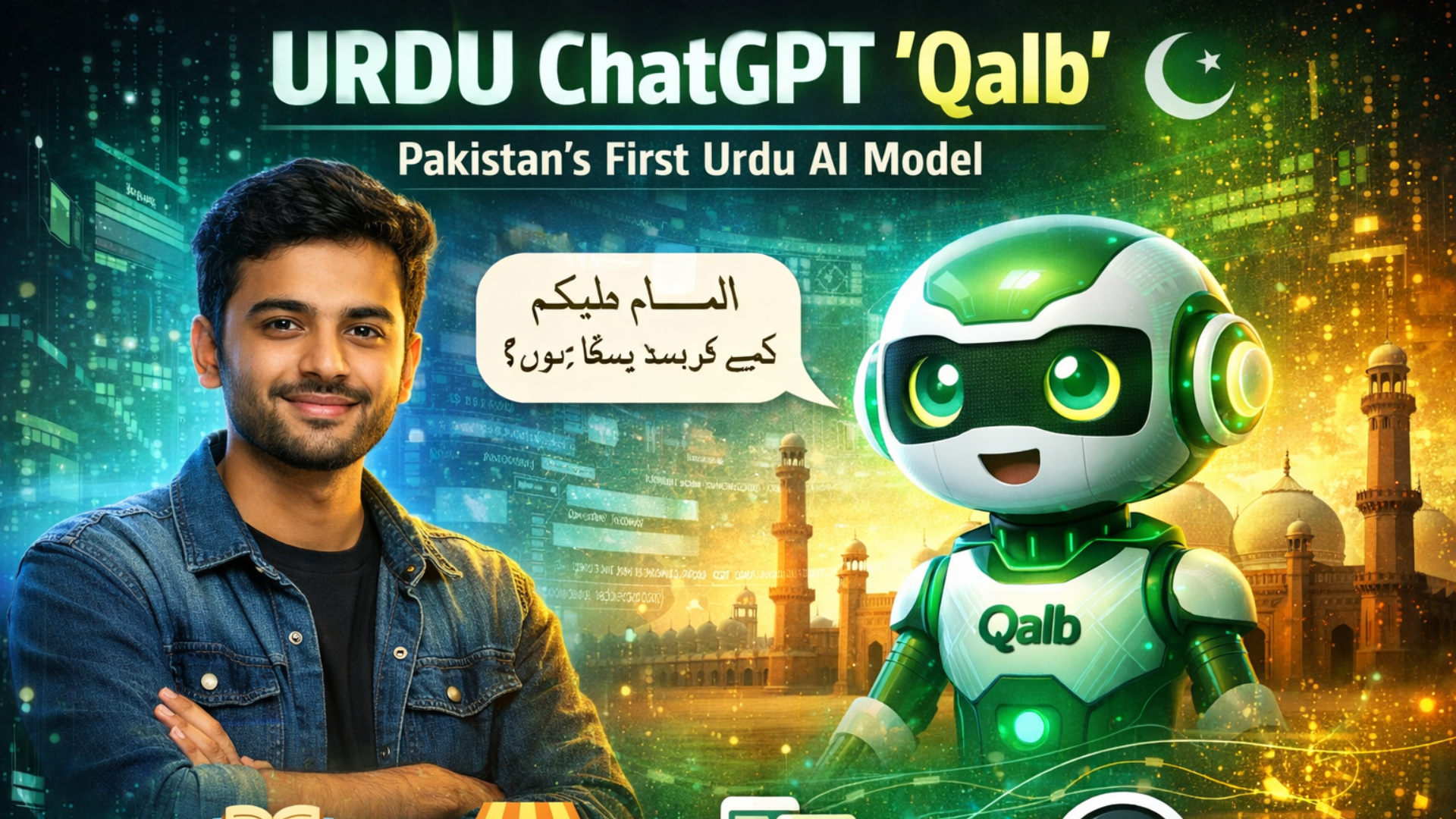

Pakistani Student Launches Urdu ChatGPT. Pakistan has taken a major step in the global artificial intelligence space with the launch of its first homegrown Urdu AI language model, named Qalb. Developed by a young Pakistani student, the model is being described as the world’s largest Large Language Model (LLM) built exclusively for the Urdu language, marking a historic moment for local-language technology.
The project highlights how Pakistani talent is contributing to advanced AI innovation on an international scale, while also addressing long-standing challenges faced by Urdu speakers in the digital world.
What Is Qalb? Pakistan First Urdu ChatGPT-Style AI
Qalb is an advanced AI language model designed specifically to understand, process, and generate Urdu text with high accuracy. Unlike general-purpose AI models that treat Urdu as a secondary language, Qalb has been trained exclusively on Urdu data, making it far more accurate in grammar, context, and cultural nuance.
The model was trained on 1.97 billion tokens, a scale never before achieved for an Urdu-focused AI system. It was also evaluated using more than seven international benchmarking frameworks, ensuring its performance meets global AI standards.
According to its development team, Qalb outperforms existing Urdu AI models on key real-world performance indicators, including comprehension, response quality, and practical usability.

Who Developed Qalb? Meet the Pakistani Student Behind the Innovation
Qalb was developed by Taimoor Hassan, a Pakistani student currently studying in the United States. Despite his young age, Hassan has already built an impressive profile in the technology and startup ecosystem.
He has:
- Launched and exited 13 startups
- Won the Microsoft Cup
- Represented Pakistan at multiple international technology platforms
Taimoor Hassan completed his Bachelor’s degree in Computer Science from FAST University, one of Pakistan’s leading technology institutions. He is now pursuing a Master’s degree in Computer Science and Software Engineering at Auburn University, where he continues to work on advanced AI and software engineering projects.
Why Qalb Matters for Urdu and Pakistan
Urdu is spoken by over 230 million people worldwide, yet it has remained underrepresented in advanced AI systems. Most global AI tools primarily support English and a handful of major languages, leaving Urdu speakers with limited access to cutting-edge digital services.

Qalb aims to close this technology gap by bringing high-quality AI capabilities to Pakistan’s national language. This development has the potential to transform how Urdu speakers interact with technology across multiple sectors.
Key Features of the Qalb Urdu AI Model
Qalb has been designed with real-world usability in mind. Some of its key features include:
- Deep understanding of Urdu grammar and context
- Accurate responses in formal and conversational Urdu
- Better handling of cultural references and expressions
- Performance tested against international AI benchmarks
- Optimized for real-world applications rather than academic use
Because it is trained specifically for Urdu, Qalb avoids many of the errors seen in multilingual AI systems that treat Urdu as an afterthought.
How Qalb Can Benefit Pakistan’s Digital Ecosystem
The launch of Qalb opens new opportunities across Pakistan’s growing digital economy. The model is designed to support:

1. Education Platforms
Urdu-based AI tutors, homework assistants, and learning tools can make education more accessible for students who struggle with English-only platforms.
2. Local Businesses and Startups
Small businesses can use Urdu AI chatbots for customer support, marketing content, and automation without needing English-language expertise.
3. Digital Services
Government portals, banking services, and utility platforms can integrate Urdu AI to improve user experience for the general public.
4. Voice-Based AI Agents
Qalb can power Urdu-speaking voice assistants, making technology more inclusive for users who prefer speaking over typing.

Team Effort Behind the Project
While Taimoor Hassan led the project, he emphasized that Qalb was the result of teamwork. He worked closely with his undergraduate teammates Jawad Ahmed and Muhammad Awais, who contributed to the model’s development and refinement.
The team stated that they plan to continue improving localized AI models, particularly for niche industries that are often ignored by large global tech companies.
Innovation Beyond Big Corporations
One of the most important messages behind Qalb is that innovation is no longer limited to large corporations with massive budgets. According to Hassan, modern technology allows small, focused teams to build powerful tools that can educate, automate, and serve millions of users.
He highlighted that with the right skills, vision, and dedication, young developers can now compete on a global level — even in complex fields like artificial intelligence.

What Qalb Means for the Future of AI in Pakistan
The launch of Qalb signals a promising future for Pakistan’s AI and technology sector. It demonstrates that Pakistani students and developers are capable of building world-class systems that address local needs while meeting international standards.
As localized AI models like Qalb continue to evolve, Pakistan could see:
- Greater digital inclusion
- Stronger local startup ecosystems
- Increased global recognition of Pakistani tech talent
- Wider adoption of AI in national languages
Conclusion
The launch of Qalb, Pakistan’s first Urdu ChatGPT-style AI model, is a landmark achievement for the country’s technology landscape. Developed by Taimoor Hassan, a Pakistani student studying abroad, the project proves that innovation, talent, and ambition can come from anywhere.
By focusing on Urdu — a language spoken by hundreds of millions — Qalb has the potential to reshape education, business, and digital services in Pakistan and beyond. It is not just an AI model; it is a step toward a more inclusive and locally relevant digital future.